

In forex trading, understanding market momentum is key to making better decisions. Many traders struggle to identify when a trend is about to change. This is where the SMI Ergodic indicator becomes useful. It helps traders spot momentum shifts with better accuracy and improve their trading strategy.
This guide explains the SMI Ergodic forex concept in simple words so you can apply it easily in your trading.
What is the SMI Ergodic Indicator?
The SMI Ergodic indicator is a type of momentum oscillator used in technical analysis. It is based on the true strength index (TSI) and helps measure price momentum in financial markets.
It works by analyzing recent price movements and smoothing them using an exponential moving average. This makes it more reliable than many other technical indicators that produce many false signals.
The indicator has two main components:
- SMI line
- Signal line (signal line EMA)
These lines help traders identify bullish momentum, bearish momentum, and possible trend reversals.
How the SMI Ergodic Oscillator Works
The SMI Ergodic oscillator focuses on the difference between the security’s closing price and its recent price range. It uses a price close double smoothed calculation to reduce noise.
Here is how it behaves:
- High positive values indicate strong upward momentum
- Low negative values show strong downward momentum
- Extreme values suggest overbought or oversold conditions
The zero line is an important level:
- Above zero line = bullish trend
- Below zero line = bearish trend
This makes it easier to identify market trends and trend direction.
Understanding the Signal Line and Crossovers
The signal line plays a major role in generating trading signals. It is usually a moving average of the SMI line.
Key signals:
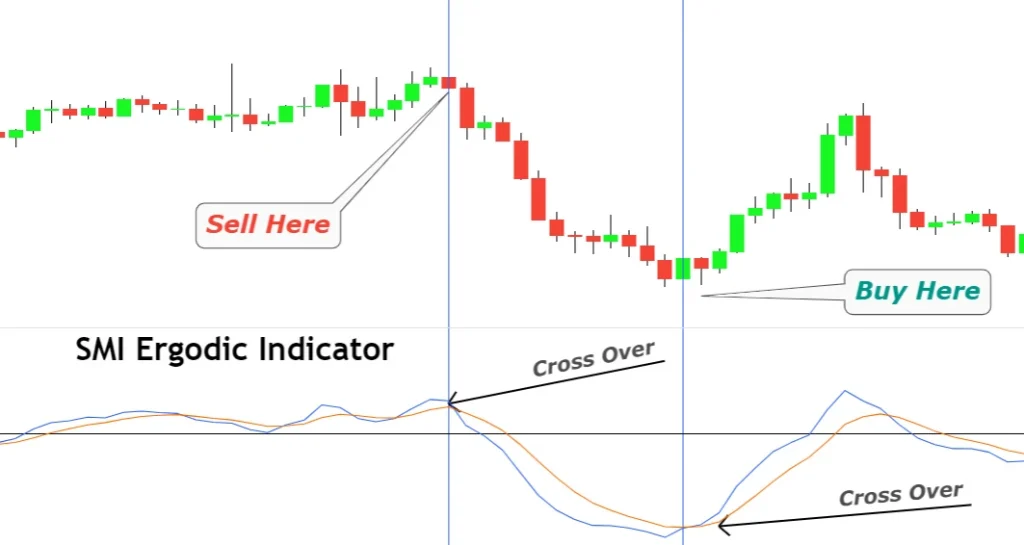
- Bullish crossover: When the SMI line crosses above the signal line → Buy signal
- Bearish crossover: When the SMI line crosses below the signal line → Sell signal
These smi line crosses are widely used by swing traders and position trading strategies.
However, in sideways markets, crossovers may lead to many false signals. So it is important to confirm signals using other analysis tools.
Identifying Momentum Shifts in Forex
The main purpose of the SMI Ergodic forex indicator is to detect momentum shifts early.
Signs of upward momentum:
- SMI line moving above zero line
- High positive values
- Bullish crossover
Signs of downward momentum:
- SMI line below the zero line
- Low negative values
- Bearish crossover
These signals help traders understand price momentum and prepare for potential trend reversals.
Using SMI Ergodic Strategy in Forex Trading
A good smi ergodic strategy combines the indicator with price action analysis and other tools.
Basic Trading Strategy:
Buy Setup:
- SMI line crosses above signal line
- Indicator moves above zero line
- Confirm bullish momentum using price action
Sell Setup:
- SMI line crosses below signal line
- Indicator moves below zero line
- Confirm bearish trend with price movements
This approach helps in finding better entry and exit points.
Combining SMI Ergodic with Other Indicators
To improve accuracy, traders often combine the SMI Ergodic indicator with other trading tools.
Useful combinations:
- Relative strength index for overbought or oversold confirmation
- Stochastic oscillator for short-term signals
- Moving average for identifying longer term trends
Using multiple analysis tools reduces false signals and improves reliable signals in volatile markets.
Spotting Overbought and Oversold Conditions
The SMI Ergodic oscillator can also identify overbought conditions and oversold conditions.
- High positive values → Overbought conditions
- Low negative values → Oversold conditions
These levels often lead to price correction or potential trend reversals.
But traders should avoid relying only on extreme values, as fast moving markets can stay overbought or oversold for longer periods.
Detecting Divergence for Better Accuracy
Divergence is another powerful feature.
Bearish divergence:
- Price makes higher highs
- Indicator makes lower highs
This signals weakening bullish momentum and possible reversal.
Bullish divergence:
- Price makes lower lows
- Indicator makes higher lows
This shows weakening bearish momentum.
Divergence helps in identifying longer term trends and improving trading strategy.
Best Timeframes for SMI Ergodic
The SMI Ergodic forex indicator works across different timeframes.
- Intraday timeframes: Useful for quick trades
- Swing traders: Best for medium-term setups
- Position trading: Helps in identifying overall trend
Choose your trading style and adjust the signal period accordingly.
Limitations of the SMI Ergodic Indicator
Like all technical indicators, it has some limitations.
- Can give many false signals in sideways markets
- May lag during fast moving markets
- Needs confirmation from other tools
This is why traders should combine it with price action and other analysis tools.
Risk Management Tips
Using the SMI Ergodic strategy without risk management can be dangerous.
Key tips:
- Always use stop-loss
- Avoid trading in unclear market conditions
- Confirm signals before entering trades
- Do not rely on a single indicator
Risk management helps protect capital in volatile markets.
Conclusion
The SMI Ergodic indicator is a powerful tool for understanding market momentum and spotting momentum shifts. It helps traders identify bullish momentum, bearish momentum, and trend strength with better clarity.
By using smi line crosses, zero line analysis, and combining it with other technical indicators, traders can improve their entry and exit points.
However, no indicator is perfect. To succeed in forex trading, always combine the SMI Ergodic oscillator with proper risk management, price action analysis, and other trading tools.
FAQs
1. What is SMI Ergodic forex indicator used for?
It is used to measure market momentum and identify momentum shifts, helping traders detect trend changes and improve trading decisions.
2. Is SMI Ergodic better than RSI?
The SMI Ergodic indicator is smoother and reduces false signals, while RSI is faster for spotting overbought or oversold conditions. Both are useful together.
3. Can beginners use SMI Ergodic strategy?
Yes, beginners can use it because it is simple. However, they should combine it with other analysis tools for better accuracy.
4. What is the best timeframe for SMI Ergodic?
It works on all timeframes, but swing traders and position trading setups often give more reliable signals than very short intraday trades.
5. Does SMI Ergodic work in sideways markets?
It can produce many false signals in sideways markets, so traders should avoid using it alone and confirm with other indicators.