Introduction

Forex trading can look confusing at first sight. Currency pairs, pips, charts, economic news, strategies and lots of other information are needed to become a successful trader. Thus, a decent book for starters would be a good choice.
Currency Trading For Dummies is a book intended to introduce you into the world of foreign exchange market. This book contains the basics of forex trading, currency movements, market analysis, and the role of risk management.
Authors of this fourth edition of the book are regarded as Paul Mladjenovic, Kathleen Brooks, and Brian Dolan; total number of pages is 416 according to Wiley.
Currency Trading For Dummies is a book aimed to explain basics of forex trading, currency pairs, market drivers, strategies and analysis, risk management. The most useful thing about this book for beginners is its structure.
Key Takeaways
- Gain an understanding of how the foreign exchange market works.
- Be aware of the economic factors that can impact currencies.
- Be familiar with fundamental and technical analysis.
- Plan your trades and set rules for entry, exit, and risk.
- Know about position size, leverage, and risk management.
- PRACTISE your trade strategy on a demo account.
- No trade system can promise to make a profit.
- Be prepared to keep learning because things change.
Who Is Currency Trading For Dummies For?
The book is designed primarily for those who have not yet traded currencies. If concepts like currency pairs, pips, leverage, support, and resistance sound foreign, then a book targeting beginners will allow you to lay a foundation prior to tackling advanced literature.
In addition, the book may prove helpful for individuals who prefer learning through organized means rather than piecing together information on forex from various internet sites.
What Is Currency Trading For Dummies?
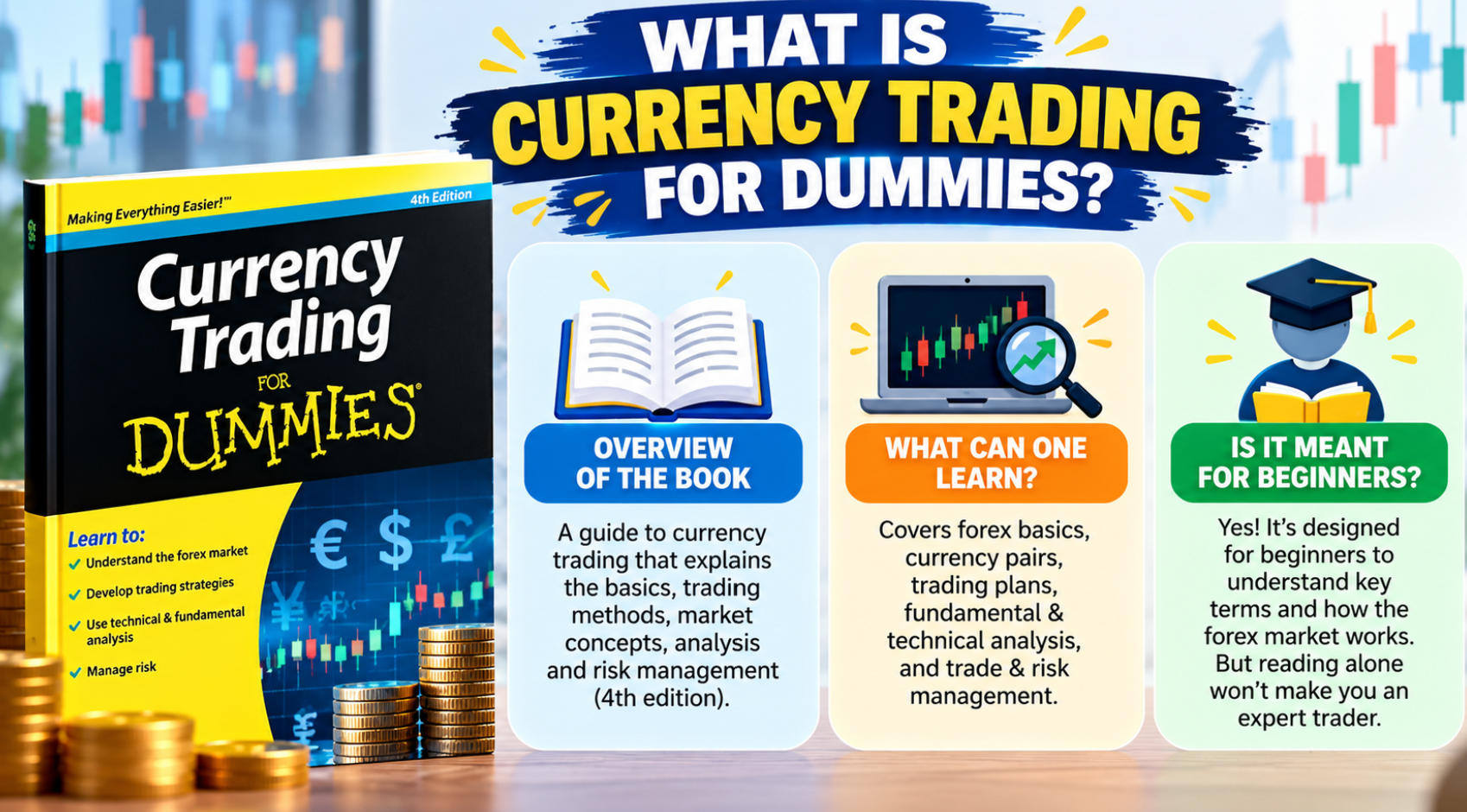
Overview of the Book
“Currency Trading For Dummies” is a guidebook dedicated to the currency trading. This book acquaints the reader with the principles of currency trading as well as with some of the methods used by the traders.
The fourth edition of this book includes a number of issues such as the basic notions of the market, planning, analysis, trade and risk management.
What Can One Learn from the Book?
This book acquaints one with the basic principles of forex trading, namely with the functioning of the market and its influencing factors.
Among other things, the book also considers the notions of currency pairs, trading plans, fundamental analysis, technical analysis, trade and risk management.
Instead of thinking about trading as a source of income, one can get acquainted with all the principles of trading before using his/her capital.
Is It Meant for Beginners?
Certainly yes, because the structure of the book is meant for those who are new to forex trading. Such a book may be useful in order to learn about the basic terminology and understanding of the market.
But reading a book will not make one an excellent trader automatically.
Currency Trading For Dummies Summary
At a high level, the book focuses on several important areas of currency trading:
- Forex market fundamentals
- Currency pairs
- Market participants
- Factors affecting exchange rates
- Trading plans
- Fundamental analysis
- Technical analysis
- Trade execution
- Trade management
- Risk management
- Trading strategies
These topics give beginners a foundation that they can build on as they continue learning.
Key Lesson 1: Understand How the Forex Market Works
What Is Forex Trading?
Foreign Exchange or Forex refers to the trading of currencies against each other. Usually, traders are concerned about the changing relationship of value between the two currencies.
For instance, EUR/USD is the euro vs. US dollar. If you trade in this pair, you will consider the change in the value of the euro versus the dollar.
Who Participates in the Forex Market?
The forex market includes different types of participants, such as:
- Banks
- Central banks
- Corporations
- Institutional investors
- Retail traders
- Speculators
Each participant can have different reasons for being involved in the currency market.
Why Currency Prices Move
Currency prices can be affected by many factors. These include interest rates, inflation, economic growth, employment figures, central-bank decisions, political developments and overall market sentiment.
Understanding these factors can help beginners see why currencies do not simply move randomly.
Key Lesson 2: Learn How Currency Pairs Work
Base and Quote Currency
A currency pair contains two currencies. The first is known as the base currency, while the second is the quote currency.
For example, in EUR/USD, EUR is the base currency and USD is the quote currency.
Major Currency Pairs
Major currency pairs are among the most commonly followed pairs in the forex market. They generally involve major global currencies and are widely watched by traders.
Minor and Cross Currency Pairs
Not every currency pair includes the US dollar. These pairs are often referred to as minor or cross pairs.
Their trading conditions can differ from major pairs, including differences in liquidity and spreads.
Pips and Price Movements
A pip is a common unit used to describe a small movement in a currency pair’s price. Understanding pips is important because traders use them to measure price changes, potential gains and potential losses.
Key Lesson 3: Develop a Forex Trading Plan
Trading without a plan can make it easier to make decisions based on emotions.
A trading plan gives you a basic framework for how you intend to trade.
Define Your Trading Goals
Start by understanding what you want to achieve and how much time you can realistically spend learning and trading.
Choose a Trading Style
Different traders use different timeframes. Common approaches include:
- Short-term trading
- Swing trading
- Longer-term trading
There is no single style that suits every trader.
Define Entry and Exit Rules
A trading plan should explain when you may enter a trade and when you intend to exit.
Set Risk Limits
It is also important to decide how much risk you are prepared to accept before placing a trade. Having these rules in advance can help prevent emotional decisions.
Key Lesson 4: Understand Fundamental Analysis
What Is Fundamental Analysis?
Fundamental analysis involves looking at economic and financial information that may affect the value of a currency.
Traders may study factors such as:
- Inflation
- Employment
- GDP
- Interest rates
- Retail sales
- Manufacturing data
Central Banks and Monetary Policy
Central banks can have a major influence on currencies. Changes in interest rates and other monetary policy decisions can affect how investors view a country’s currency.
Key Lesson 5: Learn Technical Analysis
What Is Technical Analysis?
Technical analysis involves studying historical price and market data to identify possible trends and patterns.
Beginners may come across concepts such as:
- Trends
- Support
- Resistance
- Breakouts
- Reversals
Technical indicators can also be used as part of market analysis.
However, indicators should be viewed as tools for making trading decisions, not as systems that can predict every future price movement.
Key Lesson 6: Manage the Trade, Not Just the Entry
Entry is just one aspect of trading.
Once a trader takes a position, he needs to plan on position sizing, stop losses, profit objectives, and how to handle scenarios where the market does not react as anticipated.
Planning for these situations in advance within a trading plan reduces the chances of making emotional adjustments during the active trade..
Key Lesson 7: Risk Management Comes First
Risk Management is one of the most important elements when learning forex.
Position Sizing
The size of your position determines the potential gain and loss from that position. Positioning too high without a need increases your risk in case of an unsuccessful trade.
Leverage and Margin
Leverage enables a trader to control a position by using less capital than the required amount but may also magnify the possible losses and gains.
Stop-loss and Risk Control Measures
Stop-loss order and risk management measures can allow traders to control risks as per the defined strategy.
Traders should know about the emotional trading behaviors like revenge trading, over trading, FOMO, moving stop loss and having over-sized positions.
Key Lesson 8: Practise Before Trading Real Money
Beginners can use a demo account to practise without immediately putting real money at risk.
A demo account can help you practise:
- Placing orders
- Understanding spreads
- Reading charts
- Testing a trading plan
- Managing positions
- Tracking performance
However, demo trading is not exactly the same as live trading. Real-money trading can involve different emotional and execution conditions.
Currency Trading Strategies From Currency Trading For Dummies
The book introduces the idea of developing and using different trading approaches. These can include:
Trend-Following Approaches
These focus on identifying and trading in the direction of an established market trend.
Breakout-Based Approaches
These strategies focus on price moving beyond an important level.
Range-Based Trading
Range trading looks at situations where price moves between established levels rather than following a clear trend.
Fundamental Trading
Fundamental approaches focus more heavily on economic data, monetary policy and other factors that may influence currencies.
The appropriate approach depends on factors such as market conditions, trading goals, timeframe and risk tolerance.
Best Forex Books for Beginners
| Book | Best For |
| Currency Trading For Dummies | Complete beginners learning forex foundations |
| The Forex Trading Course | Structured self-study |
| Essentials of Foreign Exchange Trading | Readers looking for practical trading concepts |
Instead of choosing a book only because it has a high rating, beginners should consider whether its content matches their current level of knowledge.
How to Learn Currency Trading From Scratch

A simple learning path can look like this:
Step 1 – Get familiar with the forex lingo: Make sure that you know some of the basic terms in the forex market, such as currency pairs, pips, spread, and leverage.
Step 2 – Get familiar with currency pairs: Understand how base and quote currencies operate.
Step 3 – Find out what influences the exchange rate: Learn some of the basics of economic indicators, interest rates, and central bank activities.
Step 4 – Get familiar with the analysis tools: Be aware of fundamental analysis and technical analysis.
Step 5 – Formulate a trading strategy: Create rules regarding the entry, exit, and risk involved.
Step 6 – Practise on a demo account: Practise with the knowledge you have without risking any money.
Step 7 – Keep records of your performance: Maintain a record of your trading experience and learn from your mistakes and successes.
What Currency Trading For Dummies Does Not Teach You
No single book can provide everything a trader needs.
It cannot provide a guaranteed profitable strategy, personalised financial advice or a guaranteed method for predicting currencies.
It is also not a replacement for current market information, regulatory guidance or continued education.
Forex markets change, so information that was useful at one point may need to be reviewed as market conditions change.
Is Currency Trading For Dummies Worth Reading?
The book is aimed at the absolute novice, at individuals who have no knowledge of forex-related terms, at people interested in an organized introduction and at individuals who learn best from books.
The book may be insufficient for forex traders with experience in search of more advanced quantitative techniques, current information about brokers or personal trading tips.
The book aims at giving a novice a basic insight into the nature of currency trading and into areas where additional study is required.
Frequently Asked Questions
What is the book “Currency Trading For Dummies” about?
This is a beginner book which explains basics of forex, currency pairs, market drivers, trading plan, analysis, trade management, and risk management.
Is “Currency Trading For Dummies” a good book for beginners?
This is a beginner book and can be helpful for those who want to learn basic forex vocabulary and concepts.
What are the main lessons from “Currency Trading For Dummies”?
The main concepts include knowledge of forex market, currency pairs, analysis, trading plan, and risk management.
Is it possible to learn forex trading with books only?
Yes, it is possible, but it is necessary to practice and know current market.
How do I learn currency trading from scratch?
You should start with learning forex vocabulary and currency pairs, then move to market drivers, analysis, trading plan, and risk management. Also practicing on demo account may be helpful.
What are the basics of the forex market?
Forex basics include knowledge of currency pairs, exchange rates, pips, spreads, market participants, and factors influencing movements of currencies.