
Whenever an individual is searching on the internet by keying in forex broker rating or broker forex rating, they are normally seeking one thing which is the plain manner of determining whether a broker should be trusted. Assessment is also commonly done of the international presence and regulation adherence of global brokers in various jurisdictions.
Broker rating is not a magic formula and it is not all about low spreads. A good rating examines safety, cost, experience in trading and the treatment of the clients in case of any go-wrong. Also, you have to select a broker, which is able to provide a valid trading environment so that your money and transactions are not lost. The happy one: it is now possible to rate brokers yourself with a straightforward checklist–without being a professional.
The following is a flimsy and practical guide that you can refer to at all times when comparing brokers to enable you to identify the best brokers based on clear-cut criteria.
What a “Forex Broker Rating” Really Means
A foreign exchange broker rating is a score which is based on the critical factors such as regulation, pricing, terms of trade, quality of the platform and customer services. Online brokers research and independent forex broker reviews are important in development of trust ratings, because they offer thorough analysis and objective ratings of various brokers. There are broker-review websites, which form their own trust, or safety, score, such as checking licenses and testing platforms. On the example, there are reviewers who create accounts and test platforms on desktop/web/mobile, and then combine it with regulation checks to create the score of trust.
You just have to do one thing: you have to identify a broker and the first thing you want is to find a safe broker, that is, secondly, one that is not expensive but third, that you are comfortable in using.
Step 1: Start With Safety (Regulation, Commodity Futures Trading Commission & Real Licenses)
When a broker is appropriately regulated, it normally implies that there exists a set of regulations concerning the way the broker has to operate, ways in which it markets its products and ways it manages to use its clients money.
The United States has legal forex trading. The Commodity Futures Trading Commission (CFTC) and the National Futures Association (NFA) regulate the legal forex trading in the U.S. The US forex traders can only be accepted by brokers who are registered as a retail foreign exchange dealer (RFED) with CFTC and members of NFA. The US forex brokers are considered to be the best when they adhere to these regulations and are known to be safe and transparent.
Some of the regulatory standards of US forex brokers are:
- At least $20 million of net capital.
- Strict reporting standards
- Major currency pairs leverage limit of 50:1.
- Isolation of client funds so as to protect them.
- The regulatory framework of the U.S. market is quite specific intended to save the traders and provide financial security.
What to do:
- Access the site of the broker and locate the section of regulations (license name + license number).
- Check it on the official register of the regulator (not in just any web pages).
Examples of official checks:
- The CFTC in the US asks traders to check firms and history with the NFA BASIC database. The list of the best US forex brokers comprises those on the list of registered retail foreign exchange dealers provided by CFTC and NFA and they satisfy all of the legal and regulatory demands of an US forex trader.
- It is common to have several different registers where you can find a match (as in, these are the FCA register and ASIC register that are usually consulted on verification).
Simple rating tip:
- Well-known regulator(s) that is fully verified = high score.
- Licensing offshore only, no ownership, or no license number = low score.
Step 2: Understand Retail Protections (Especially for CFDs)
There are numerous forex brokers that deal with CFDs. It is also worth mentioning that a large percentage of retail investor accounts lose money when trading leveraged products such as the forex and CFDs hence the importance of regulatory protection. Regulators in various jurisdictions insist on certain safeguards of retail clients- leverage limits, margin close-out, risk warnings and negative balance guarantees.
The trading environments are regulated to safeguard the accounts of retail investors and the cfd traders by placing limits on leverage, margin regulations and obligatory disclosures of risks. The retail forex and trading CFDs offered by regulated brokers to retail clients are only offered by regulated brokers, which ensures the industry standards are upheld and the money of the clients is not misused.
In illustration, some of the essential protections of CFDs that ESMA has focused on include availability of leverage limits, margin close-out, negative balance protection, and incentive limitations.
The significance of this to your rating:It is typical of a broker with good retail protection rules (amazed by explaining what they are) to be rated at a better safety level than a broker who conceals their rules or pressures them to take excessive leverage without defining the risk involved.
Step 3: Rate Trading Costs & Competitive Spreads the Right Way
A common mistake is choosing a broker only because it advertises “low spread.” It’s important to distinguish between trading fees—such as spreads and commissions, which are directly related to executing trades—and non-trading fees like overnight (swap) fees, inactivity fees, and currency conversion fees. Transparency in all trading fees is crucial for understanding your real trading cost, which depends on:
- Spread (difference between buy and sell)
- Commission (often on RAW/ECN-style accounts)
- Swap/overnight fees (for positions held overnight)
- Extra fees (withdrawal fees, inactivity fees, conversion fees)
Some rating systems explicitly measure spreads, commissions, swap rates, and even execution factors like slippage.
Simple rating tip: Ask the broker (or check the site) for an example cost on a standard lot for a major pair, including commission. If pricing is easy to find and consistent, score it higher.
Step 4: Execution Quality
Execution quality affects your results more than many traders realize—especially if you scalp, day trade, or trade news.
Regulated brokers must adhere to strict trading practices to ensure fair and transparent execution. A secure trading environment and seamless trading experience are key indicators of a broker’s commitment to quality execution.
You can’t perfectly measure execution from marketing claims, but you can look for signals:
- Does the broker talk clearly about execution model and slippage?
- Is there a stable platform during active sessions?
- Are order types and fills reliable on a demo and (later) a small live account?
Some broker evaluation approaches include execution speed and slippage as part of “trading conditions.”
Simple rating tip:If a broker is transparent about execution and your demo experience is smooth during busy market hours, score it higher.
Step 5: Trading Platforms & Tools
A broker can be safe and cheap, but if the platform is slow or confusing, you’ll hate trading. Choosing a reliable forex trading platform or fx trading platform is crucial—look for features like fast execution speed, advanced charting, and automation capabilities. The best fx trading platform is often recognized through industry awards and rankings for its features, reliability, and suitability for algorithmic trading. User friendly trading platforms are especially important for beginners, offering intuitive navigation and a smooth trading experience, but experienced traders also benefit from platforms that are stable and easy to use. Leading platforms now offer advanced features such as algorithmic trading and copy trading, enabling automation and the ability to follow expert strategies.
Check:
- Platform options (web, desktop, mobile)
- Charting tools, alerts, one-click trading
- Stability and login reliability
- Demo quality (speed, price feed, order handling)
Top forex brokers offer a variety of trading platforms, including MetaTrader 4 (MT4) and MetaTrader 5 (MT5), competitive spreads, access to multiple asset classes (such as CFDs on commodities, indices, and cryptocurrencies), and advanced trading tools and analytics.
Some reviewers explicitly test platforms across devices as part of their broker review process.
Forex Trading News and Market Analysis: Why It Matters in Broker Ratings
Staying ahead in the fast-moving forex market requires more than just a reliable trading platform or tight spreads—it demands access to timely forex trading news and in-depth market analysis. When evaluating forex brokers, the quality and availability of these resources can make a significant difference in your trading journey.
The best forex brokers understand that both beginner and experienced traders rely on up-to-date information to make smart decisions. That’s why leading online forex brokers offer comprehensive market analysis, including both technical and fundamental insights, directly within their trading platforms or through dedicated news feeds. Whether you’re trading major currency pairs or exploring multiple asset classes, having access to expert analysis helps you spot trends, anticipate market moves, and refine your trading strategies.
A regulated broker that provides robust market analysis and news feeds not only enhances your trading experience but also demonstrates a commitment to transparency and trader education. In the United States, the Commodity Futures Trading Commission (CFTC) and the National Futures Association (NFA) oversee the forex market, ensuring that forex trading is legal and that brokers operate under strict guidelines to protect retail traders. Choosing a broker regulated by these authorities means you can trade forex with confidence, knowing your interests are safeguarded.
Advanced trading tools are another key factor. Top forex brokers offer platforms like MetaTrader 4 (MT4) and MetaTrader 5 (MT5), which come equipped with powerful charting tools, technical indicators, and even automated trading capabilities. These advanced trading platforms allow you to analyze the foreign exchange market in real time, test trading signals, and execute trades efficiently—whether you’re at your desk or using a mobile app on the go.
Competitive trading conditions are also essential. The best forex brokers provide tight spreads, low commissions, and fast execution speeds, giving you the edge you need in a highly competitive environment. Many brokers also offer a variety of trading instruments—such as forex, commodities, indices, and cryptocurrencies—so you can diversify your portfolio and adapt your trading style as you gain experience.
When comparing brokers, don’t overlook the importance of retail CFD accounts, a wide selection of trading instruments, and flexible account types. A broker that caters to both retail and professional traders, with a range of account options and a user-friendly trading platform, can support your growth from your first trade to more advanced strategies.
In summary, access to high-quality forex trading news and market analysis is a crucial part of any broker’s offering. It empowers you to make informed decisions, manage risk, and seize opportunities in the foreign exchange market. As you build your forex brokers list, prioritize those that combine advanced trading tools, comprehensive analysis, competitive trading conditions, and strong regulatory oversight.
Step 6: Deposits, Withdrawals, and Support
This is where many brokers “feel good” or “feel bad.”
Rate them on:
- Clear deposit/withdrawal methods and timeframes
- Transparent fees
- Support channels (chat, email, phone)
- Response time and helpfulness
Some rating frameworks include customer support responsiveness and quality as a core scoring category.
Simple rating tip:
Before you deposit, message support with 2–3 real questions. If answers are clear and fast, score it higher.
A Simple 100-Point Forex Broker Rating & Forex Broker Reviews You Can Use
Here’s a clean scoring model you can apply to any broker:
1) Regulation & Trust (30 points)
- Verified license(s), clear legal entity, transparent ownership
2) Retail Protections & Policies (15 points)
- Clear margin rules, negative balance protection (where applicable), clean risk disclosures
3) Trading Costs (20 points)
- Competitive spreads/commissions, clear swap info, minimal hidden fees
4) Execution & Stability (15 points)
- Smooth fills, low slippage complaints, platform uptime
5) Platform & Tools (10 points)
- Strong mobile/web/desktop experience
6) Funding & Support (10 points)
- Easy withdrawals, helpful support
7) Trading Accounts (evaluate variety and features)
- Assess the range of trading accounts offered, such as commission-free options, account types, and account management features.
How to use it: Shortlist 3 brokers → score each one → pick the highest score that also feels easy to use.
For example, a broker might receive a 4.5/5 rating for platform quality or customer service, highlighting their excellence in those specific categories.
Common Red Flags That Lower a Broker Rating Fast
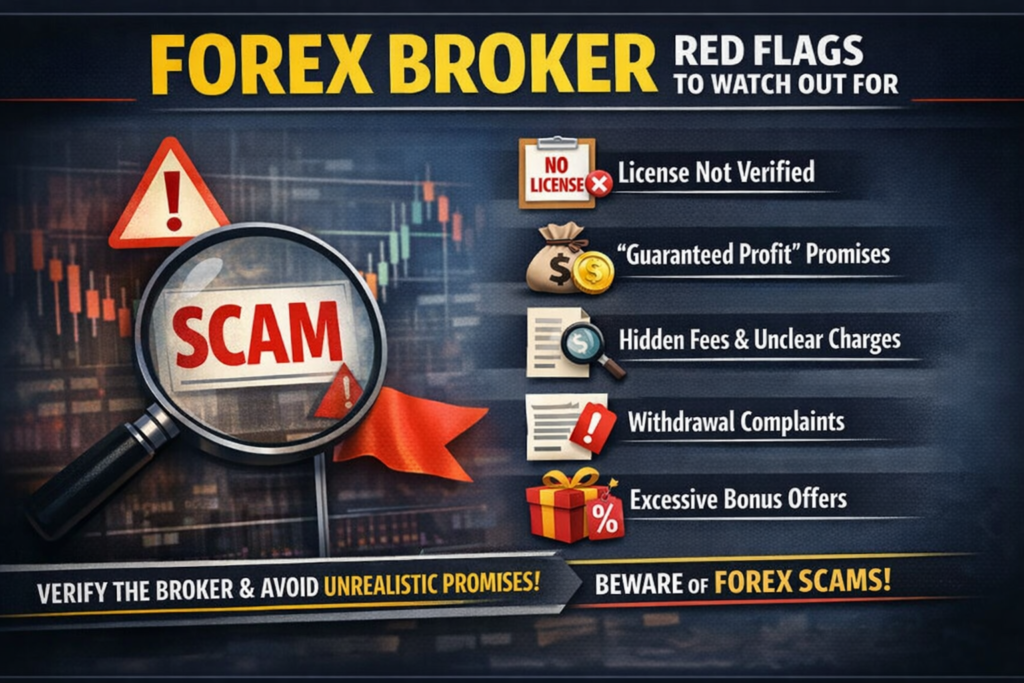
- License info missing or cannot be verified on an official register
- Promises of “guaranteed profit” or pressure tactics
- Hard-to-find fee pages, unclear swaps/commissions
- Withdrawal complaints that sound consistent and repeated
- Bonus-heavy promotions that distract from real trading conditions (some regulators restrict incentives for CFDs)
- Be cautious of forex scams: Always verify the broker’s legitimacy and be skeptical of unrealistic promises to avoid falling victim to fraudulent schemes
Conclusion: A Smart Rating Is a Balanced Rating
A strong forex broker rating is not about hype. It’s about trust, clarity, fair costs, stable trading, and good support. If you follow the steps above, you’ll avoid most bad choices—and you’ll feel confident because your decision is based on facts you can verify.
FAQs
1) What is the best way to check a broker’s regulation?
Find the license number on the broker’s site, then confirm it on the regulator’s official register (or NFA BASIC in the US).
2) Is a low spread always the best choice?
Not always. Your real cost can include commissions, swaps, and other fees. Compare the full cost, not just the spread.
3) Why do broker ratings differ from website to website?
Because each site uses different methods—some focus more on regulation, others on pricing, platforms, or testing experience.
4) What protections should retail traders look for in CFD brokers?
Common protections include leverage limits, margin close-out rules, and negative balance protection (depending on region).
5) What’s one quick test before depositing money?
Use a demo, then contact support with real questions about fees and withdrawals. Helpful, clear answers are a good sign.