
Understanding when the forex market is moving into the trending state or when it is going into a quiet and slow period of consolidation is one of the most useful analytical tools that any trader can learn practically. The Gopalakrishnan Range Index or GAPO forex indicator is a market range indicator of unique and mathematical beauty that quantifies the rate of trading range expansion or contraction of an exchange rate between an instrument over a given time interval. Traders often use a price chart to visualize market movements and identify price gaps, which are key elements in technical analysis.
Developed by Jayanthi Gopalakrishnan, the Gopalakrishnan Range Index forex tool uses logarithmic mathematics to create a normalized and highly sensitive measurement of range expansion and contraction by calculating the difference between the high and low prices over a given period.
In this blog, we will discuss what exactly the GAPO indicator is, how to interpret it correctly, and how to apply it in practice in order to match your trading strategy to the existing condition of market range processes, a valuable tool in technical analysis for identifying market expansion and contraction.
What Is the Gopalakrishnan Range Index?
The GAPO forex indicator is given by the calculation of the logarithm of the high maximum-low minimum of a given lookback period divided by the logarithm of the lookback period. This logarithmic solution produces a measurement that is normalized and can be directly compared across currency pairs and different time periods, which makes the Gopalakrishnan Range Index forex tool truly adaptable and generalized in a multi-market analysis structure.
The outcome is shown as a solitary oscillating line, which increases when the trading range is widening, based on the number of periods counted, and decreases when the trading range is narrowing, based on the count of periods taken. An increasing GAPO means that price is gaining more on a period than historical averages, and this is a positive development of increasingly expanding volatility and the emergence of a trending market environment that is worth following.
A decreasing GAPO means that price is making less ground per period than the lookback history implies and indicates that volatility is narrowing and that a consolidation or ranging market character is evolving that would be more amenable to mean reversion strategies.
Range Index and Market Volatility
The Gopalakrishnan Range Index (GAPO) serves as a powerful indicator for assessing market volatility and understanding how the price range of an asset evolves. By closely monitoring the range index, traders can pinpoint periods of low volatility, which often precede significant market moves such as breakouts or trend continuation. When the GAPO signals a period of low volatility, it suggests that the market is consolidating and that a breakout may be imminent, offering traders valuable entry and exit points.
Conversely, when the range index indicates high volatility, it may signal that the market is experiencing a contraction or even an exhaustion gap, where the current trend could be losing momentum. This insight allows traders to anticipate potential reversals or periods of sideways movement. In forex trading, the GAPO is especially useful for analyzing the volatility of major currency pairs, including the US dollar, helping traders identify optimal trading opportunities in dynamic market conditions.
By integrating the Gopalakrishnan Range Index into their trading toolkit, traders gain a clearer perspective on market volatility, enabling them to make more informed decisions about when to enter or exit trades. Whether trading forex, stocks, or other assets, understanding the behavior of the range index can provide a significant advantage in navigating periods of both expansion and contraction in the market.
How to Read the GAPO Indicator
To read the GAPO forex indicator properly, one must have an idea of not only the direction of the GAPO line but also its level in comparison to how the indicator has read in the past on the exact currency pair and at the time you are looking at. When the Gopalakrishnan Range Index forex line is showing movement towards the high as the base level, it is an indication that the market range is just starting to widen after some compression, which usually follows the growth of a new and meaningful directional movement in the currency pair.
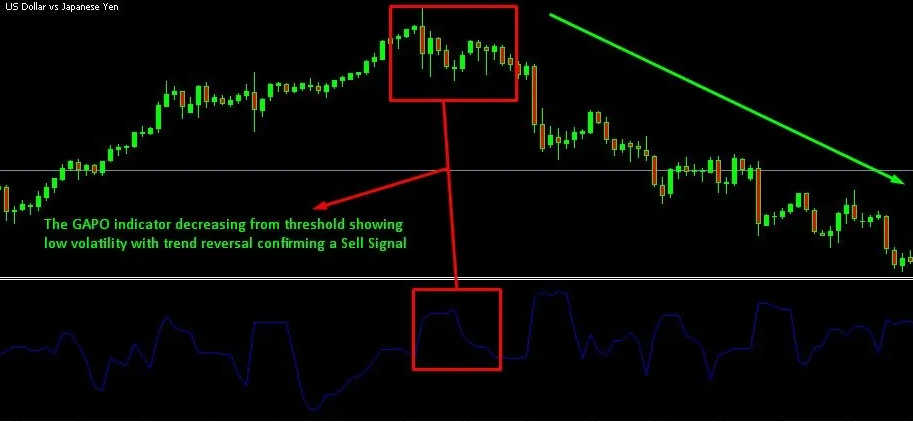
When the GAPO forms historically high levels compared to its more recent range on the chart, it is an indication that the market expansion phase may be approaching maturity, and volatility will be approaching an extreme that likely will be the precursor to a slowdown or even reversal of the expansion. As the GAPO is declining out of high values toward its historical average, this shows that the market range is shrinking after it has been expanding and therefore returning to low volatility levels that will support range-bound and mean reversion trading styles.
The most practically effective GAPO readings are the changes between low and rising conditions on the one end and high and falling conditions on the other, since the transitions are used to determine the most notable moments when the market conditions are changing between trending and ranging market conditions.
Measuring Market Contraction
Market contraction is characterized by a narrowing price range, signaling that the asset is experiencing reduced volatility and potentially setting the stage for a breakout or a reversal in the current trend. The Gopalakrishnan Range Index is an effective tool for measuring this contraction by tracking the range index over a specified period. When the GAPO shows a decreasing trend, it suggests that the market is contracting, which often precedes a significant price move.
For traders, recognizing a contracting market is crucial for adjusting their trading strategy and identifying timely entry and exit points. For example, in the stock market, a steadily declining range index may indicate that a breakout or trend reversal is on the horizon. By monitoring the GAPO, traders can position themselves to capitalize on these shifts, whether by preparing to enter a new position as the breakout occurs or by locking in profits before a reversal.
Using the Gopalakrishnan Range Index to measure market contraction empowers traders to anticipate changes in price trends and adapt their strategies accordingly. This proactive approach helps maximize profits and minimize risks, making the GAPO an essential component of any robust trading strategy.
GAPO as a Strategy Selection Tool
Among the most useful and at the same time the most practical uses of the Gopalakrishnan Range Index forex indicator is applying it as a dynamic strategy selection tool, which informs traders which direction is best suited to the market conditions.
The idea that when GAPO is low and starting to increase is that the market is moving out of a stage of consolidation to an expansion stage, and therefore, trend-following strategies become more and more suitable as the range starts to gain directional momentum. Gap trading and gap trading strategies can also be aligned with the market phase identified by the GAPO indicator, allowing traders to capitalize on price gaps that often occur during transitions between consolidation and expansion.
When the GAPO is high and starting to decline, it is an indication that the expansion phase is now over, and the mean reversion or range-trading plans are increasingly becoming more suitable as volatility subsides back to its historical mean. This dynamic alignment of strategy using GAPO readings eradicates one of the most frequent and most expensive errors traders make, which is to use trend-following strategies in low-range consolidations or mean reversion strategies in high-range trending markets that are totally inappropriate to both strategies.
It is much better to use the GAPO as your major condition classifier in the market and then choose any other technical signal, which will provide you with better consistency and reliability of your trading performance in various currency pairs and market stages. This approach supports more informed investing decisions by helping traders and investors adapt to changing market volatility.
Combining GAPO With Breakout Strategies
The GAPO forex indicator is one of the most potent tools that the breakout trader would prefer to have objective assurance that the market possesses the range expansion properties that would support a meaningful breakout move beyond a significant support or resistance level.
Breakaway gaps often occur at the start of a new trend, especially when the market opens at the beginning of a trading day, signaling a decisive move as price breaks through key support or resistance levels. A low GAPO value with a converging price pattern like a rectangle, triangle, or pennant forms a good quality setup in which a breakout is most likely to be ample and sustained as opposed to a short-term false signal that soon turns around.
As the GAPO starts to increase, coinciding with the price breaks above a resistance level or below a support level, these breaks can result in breakaway gaps or even a runaway gap, both of which are indicative of a strong trend. The market offers objective evidence that the market is entering an expansion phase, which helps to sustain the direction of the breakout.
The volume confirmation by use of tick volume bars, plus the increase in GAPO and the breakout pricing structure, all make up a three-factor confirmation system that will materially decrease the number of false breakout entries in your trade.
A combination of GAPO expansion signals and breakout price patterns, along with volume confirmation, is one of the most comprehensive and objectively constructed breakout trading frameworks that can be applied by a retail forex trader. Monitoring for breakaway gaps and runaway gaps at market opens can help traders identify the emergence of a new trend and capitalize on strong trend movements during the trading day.
Combining GAPO With Mean Reversion Strategies
Just as strong is the use of the Gopalakrishnan Range Index forex indicator in the scenario of mean reversion strategies, where traders prefer to determine that the market is truly in a low-expansion, range-bound state and only then move to the borders of the existing range. A declining or low historical average GAPO indicates that the market is in a contractionary range, a market where price changes are constrained, and extreme reversions are more predictable and reliable as compared to expanding volatility situations.
In these conditions, common gaps and exhaustion gaps often occur, providing opportunities for traders to anticipate price returns as the price tends to revert to previous levels after such gaps.
A low GAPO with regression channel boundary signals makes a very high confirmed mean reversion formation, where many independent indicators concur that the market is either in an extreme based on a contracting range. The GAPO also assists mean reversion traders in managing their exits in a better way. When the GAPO starts to climb at the time when it seemed to be in the range-bound period, then it means that a breakout is forming, and open mean reversion positions should be defended in the best way possible to avoid the accumulated profits.
Traders may also take positions in the opposite direction of a gap, especially when expecting the gap to fill within the same day, capitalizing on rapid corrections and price returns.
This defensive application of the GAPO as an exit management tool is one of its most underappreciated and practically valuable uses in a complete mean reversion trading framework. If you are looking for a professional and well-structured trading environment with advanced charting tools and competitive trading conditions, Suxxess FX offers a feature-rich platform, tight spreads, dedicated client support, and a free demo account.
Practical GAPO Trading Strategy
To construct a practical and systemically usable trading plan based on the GAPO forex indicator, it is necessary to incorporate its range expansion and range contraction indicators with definite entry indicators, rational placement of the stops, and a goal to take profit.
A simple expansion-following breakout plan would be to wait until the GAPO reaches a historically low value indicating compression and then take a long position by the time that price breaks out above an important resistance level, the GAPO is rising, and institutional participation in the action is supported by volume bars. Stop losses can be set just below support levels, and the closing price is often used to determine entry and exit points. Gaps often occur at key market moments, and low volume can signal a false breakout.
Set your stop loss right below the breakout point at entry, and set a profit goal based on the height of the previous range of consolidation and extrapolate it upwards off the point of breakout to a well-defined and measurable reward target.
In the case of using a contraction-based mean reversion strategy, one should wait until the GAPO is declining at a high price level to the average, and enter a short position at the upper regression channel boundary when the RSI indicates overbought and the GAPO indicates that the range is contracting and not expanding. Consider executing a sell order when these conditions are met.
Never implement any GAPO strategy on a live trading account without first backtesting it on a variety of combinations of currency pairs and at a variety of market conditions to get to know all the performance traits and best parameter combinations of that particular strategy. It is also important to understand how to trade gaps effectively as part of a comprehensive trading plan.
Best Practices for Trading
To get the most out of the Gopalakrishnan Range Index, traders should adopt a disciplined approach that combines the GAPO with other technical indicators and thorough market analysis.
- One of the best practices is to use the GAPO alongside moving averages and other indicators to confirm trading signals and enhance the reliability of entry and exit points.
- Analyzing support and resistance levels is also critical, as these price levels often act as catalysts for breakouts or reversals, especially when confirmed by changes in the range index.
- Staying aware of the current trend and overall market conditions allows traders to align their strategies with prevailing market sentiment. For instance, if the GAPO indicates a trend continuation, traders can confidently follow the trend, while a contracting range index may prompt a more cautious or contrarian approach.
- Proper risk management is essential; setting stop loss orders helps protect against unexpected market moves and limits potential losses.
In the forex market, these best practices are particularly valuable for identifying and trading gaps, taking advantage of market volatility, and adapting to rapidly changing conditions. By integrating the Gopalakrishnan Range Index with other analytical tools and maintaining a disciplined trading routine, traders can maximize their advantage, improve their decision-making, and achieve more consistent results in their trading endeavors.
Final Thoughts
The Gopalakrishnan Range Index is a truly unique and analytically potent market range indicator that would give the forex traders an equivalent of mathematically normalised and actionable direct measurement of market expansion and contraction dynamics that cannot be comprehensively replicated by conventional volatility measures. It can be used either as a strategy selection filter, to so to speak match your trading strategy with the governing market conditions, or a mean reversion qualifier to verify true contraction conditions, but either way, the GAPO forex indicator is a welcome and unique addition to any complete trading framework that is complete.
When considering Gopalakrishnan Range Index forex analysis along with the momentum indicators, volume tools, price structure levels, and volatility measures, one will have a complete and multi-layered approach. Having a mastery of the GAPO forex signals, you will be in a much better position to position your trading plans with the market conditions perfectly.